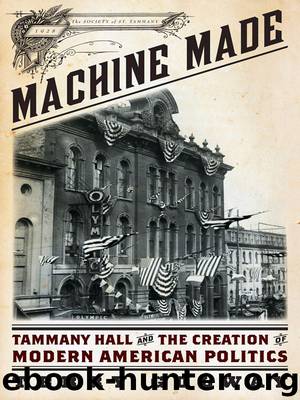
Machine Made: Tammany Hall and the Creation of Modern American Politics by Terry Golway
Author:Terry Golway [Golway, Terry]
Language: eng
Format: epub
Publisher: Liveright
Published: 2014-03-03T00:00:00+00:00
Born in 1858 in the Gas House District, which extended from Fourteenth Street to Twenty-Eighth Street on the East Side, Charles Francis Murphy personified a stereotypical Irish-American success story in politics. His parents were Irish immigrants—his father fled during the Famine in 1848—and they lived in one of the district’s many tenement houses that surrounded Stuyvesant Square’s island of affluence. One of nine children, young Charlie dropped out of school at the age of fourteen, taking a succession of jobs near the East River waterfront before becoming a horsecar driver in the late 1870s. He opened his first saloon in 1880 and soon had enough money to open three more. Murphy’s two older brothers already were active in city politics, so Charlie followed their path. His reputation as an athlete—he was not only a good baseball player but also a fine oarsman—and his involvement in the saloon trade allowed Murphy to rise quickly in local politics, to the chagrin of critics who saw Tammany’s embrace of sporting men, like the future owner of the New York Yankees, Congressman Jacob Ruppert, and saloon owners as insults to the memory of the nation’s founders.
When Tammany bestowed a congressional nomination on Big Tim Sullivan, a product of Five Points poverty who gained local fame when he slugged a prizefighter accused of wife-beating, the New York Times fulminated that “anywhere outside a Tammany barroom it would be supposed that Sullivan could be elected to Congress only in a district inhabited by the very scum of the earth.” Sullivan, the paper charged, was “simply not fit to be at large in a civilized community.” Perhaps, but Big Tim Sullivan wasn’t asking to be admitted to civilized society. He was running for Congress.11
Despite Murphy’s slender academic credentials, tenement upbringing, athletic interests, and saloon ownership, he quickly earned a reputation for running a clean operation in the Gas House District. “One thing that I learned from . . . Charles F. Murphy of Tammany Hall was a firm belief in the strength of clean government,” wrote Edward Flynn, who took over the Bronx Democratic Party at Murphy’s behest in 1922 and went on to become a key adviser to Franklin D. Roosevelt. “Mr. Murphy did not believe that politics should have anything to do with either gambling or prostitution. He further believed that politicians should have very little or nothing to do with the Police Department or the school system.”12
Flynn’s testimony on Murphy’s behalf spoke to the very different ways in which progressive reformers and Tammany liberals defined clean government. For progressives, whether they were Republicans who admired Theodore Roosevelt, Democrats who saw Woodrow Wilson as an ideal reformer, or independents forever in search of a nonpartisan hero to deliver them from grimy politics, clean government meant government devoid of patronage, interest, and politics itself. The model, at least at the municipal level, was an apolitical commission-style government implemented in Galveston, Texas, in 1900. Commission governments limited the role of mayors and emphasized the professional expertise, not the political connections, of elected commissioners.
Download
This site does not store any files on its server. We only index and link to content provided by other sites. Please contact the content providers to delete copyright contents if any and email us, we'll remove relevant links or contents immediately.
| Anthropology | Archaeology |
| Philosophy | Politics & Government |
| Social Sciences | Sociology |
| Women's Studies |
The Secret History by Donna Tartt(19097)
The Social Justice Warrior Handbook by Lisa De Pasquale(12193)
Thirteen Reasons Why by Jay Asher(8915)
This Is How You Lose Her by Junot Diaz(6891)
Weapons of Math Destruction by Cathy O'Neil(6283)
Zero to One by Peter Thiel(5805)
Beartown by Fredrik Backman(5763)
The Myth of the Strong Leader by Archie Brown(5511)
The Fire Next Time by James Baldwin(5452)
How Democracies Die by Steven Levitsky & Daniel Ziblatt(5221)
Promise Me, Dad by Joe Biden(5155)
Stone's Rules by Roger Stone(5089)
A Higher Loyalty: Truth, Lies, and Leadership by James Comey(4965)
100 Deadly Skills by Clint Emerson(4929)
Rise and Kill First by Ronen Bergman(4792)
Secrecy World by Jake Bernstein(4755)
The David Icke Guide to the Global Conspiracy (and how to end it) by David Icke(4721)
The Farm by Tom Rob Smith(4516)
The Doomsday Machine by Daniel Ellsberg(4492)
